GPT-6 Astra: A new generation of intelligence
- ID: 0f3b76bc
- 原文链接: https://openai.com/index/gpt-6-astra
- 作者: OpenAI
- 日期: 2026-09-11
- 平台: blog
- 来源类型: article
- 标签: openai, gpt-6-astra, model-release, computer-use, coding, cybersecurity, field-note
- 质量评分: 5/5
- 抓取时间: 2026-09-11T15:54:30+00:00
- 抓取状态: ok
中文导读
OpenAI 官方发布 GPT-6 Astra,称其是新一代智能模型,面向计算机操作网页浏览软件工程网络安全科学和专业工作逐步推出页面给出 Terminal-Bench ScienceAgents Last ExamOSWorld 2.0Terminal-Bench 4.0ExploitBenchSRE-BenchARC-AGI-3 等基准,并强调 Codex 将引入跨上下文保留/检索上下文的实验能力可用性方面,Astra 将开放给 ChatGPT Plus/Pro/Business/EnterpriseOpenAI APIAzure 和 AWS Bedrock;API 标准价为 $10/M input$50/M output,Fast mode 价格翻倍
为什么值得关注
Astra 官方页是本轮 OpenAI 旗舰模型发布的主合同源:能力价格Codex 上下文机制与 cyber 风险口径都在这里
English summary
OpenAIs launch page presents GPT-6 Astra as a new generation model for computer use, web browsing, software engineering, cybersecurity, science and professional work. It reports benchmark gains across computer-use, coding, science, cyber and abstract-reasoning suites, describes new Codex context-retention behavior, and states rollout to ChatGPT tiers plus OpenAI API, Azure and AWS Bedrock with standard API pricing of $10/M input and $50/M output tokens.
图片
抓取内容(opencli-first)
GPT
原文链接: https://openai.com/index/gpt-6-astra/
GPT-6 Astra: A new generation of intelligence
新一代智能
来自 iframe: https://openai.com/zh-Hans-CN/index/gpt-6-astra/
00:00
我们正式推出 GPT‑6 Astra,这是全球智能程度最高且最符合人类意图的模型。
GPT‑6 Astra 汇聚了我们多年来在预训练、强化学习和对齐领域的研究成果与重大投入。Astra 在计算机操作、网页浏览、软件工程、网络安全、科学和专业工作领域均处于领先水平。Astra 在 FrontierMath Tier 4 中取得 98% 的成绩,达到该层级测评上限;此前,它还曾帮助解决数学领域长期悬而未决的问题。Astra 在 ARC-AGI 3 上取得 99.9% 的成绩,并在 ExploitBench 上获得 100% 的满分。它还在计算机和浏览器使用方面树立了新的标杆,能够以无与伦比的速度、准确性和判断力处理最严苛的专业工作。
GPT‑6 Astra 即日起面向部分组织逐步推出,并将在未来几天内向所有 ChatGPT Plus、Pro、Business 和 Enterprise 用户开放,用户也可通过 OpenAI API、Microsoft Azure 和 AWS Bedrock 使用。
Terminal-Bench Science 0.1
API 成本输出 Token 数API 成本
GPT-6 Astra
GPT-5.6 Sol
Claude Fable 5.1
Claude Fable 5
Claude Opus 5
_Terminal-Bench Science 0.1 用于测试智能体能否使用代码和终端工具完成科学研究工作流,包括分析数据、运行模拟和拟合模型。在所比较的模型中,GPT‑6 Astra 以 64.6% 的得分创下新高;相比之下,Claude Fable 5.1 为 52.6%,预估 API 成本降低约 31%。在成本更低的情境下,Astra 得分为 61.1%,而 GPT‑5.6 Sol 的最佳得分为 22.4%;同时 Astra 的预估 API 成本降低约 27%。_
“在 ARC-AGI-3 上,Astra 在 96% 的关卡中超越了我们的人类动作效率基线,实际上在该基准测试中达到了与人类表现持平的水准。这不仅是我们迄今测试过的最佳模型,也代表着前沿模型性能意义重大的阶跃式提升 - 这不仅体现在该模型探索并解决全新环境中任务的能力上,也体现在它学习如何实现这一目标的效率上。”
Greg Kamradt,ARC Prize Foundation
Astra 是我们对齐程度最高的模型,在理解用户意图和模型行为方面都有显著提升 — 你可以安心将任务委派给 Astra,并信任其判断。作为测试这一点的方式之一,我们基于 Hugging Face 事件构建了一项新的评估,用于考量模型在面对困难或不可能完成的任务时,是否会超出其预期范围。在没有生产环境防护措施的情况下,GPT‑5.6 Sol 在 48% 的案例中超出授权目标;相比之下,GPT‑6 Astra 的比例则为 0%。
全球最佳计算机操作模型
GPT‑6 Astra 在计算机操作的速度、准确性和安全性方面迈出了新的一步。它可以处理填写在线表单、更新 CRM 中的客户记录和整理日历等繁琐任务。它可以开展在线调研,并在电子邮件或文档编辑器中撰写摘要。它可以分析科学数据、生成图表、创建网站,并运行前端 QA 检查,以确保该网站上的所有功能都能正常运行。它可以帮助你自主安装和测试软件,并排查你在屏幕上看到的问题。这些改进也体现在我们业界领先的评估结果中。
_Agents’ Last Exam 用于测试智能体在真实软件中完成复杂专业任务的能力,涵盖金融建模、工程和媒体制作等领域。在这项对比测试中,GPT‑6 Astra 以 59.3% 的得分创下新高;相比之下,Claude Opus 5 为 55.5%,GPT‑5.6 Sol 则为 53.6%。在各自得分最高的设置下,Astra 的输出 Token 数也比 Opus 5 少约 65%。_
这些改进也显著提升了真实知识型工作任务中的效率。在 OSWorld 2.0 的延迟模拟中,Astra 的计算机操作能力更强,且每项任务用时比 GPT‑5.6 Sol 少约 47%,前者的得分为 72.6%,每项任务约需 40 分钟;相比之下,GPT‑5.6 Sol 的得分为 65.7%,每项任务约需 75 分钟。3
GPT‑6 Astra 的计算机操作能力体现在跨领域的输出中,包括游戏开发、电气工程和日常知识型工作:
来自 iframe: https://openai.com/zh-Hans-CN/index/gpt-6-astra/
00:00
_这是一段 15 秒的精简版回放视频,用于展示 GPT‑6 Astra 在 KiCad 中规划印刷电路板 (PCB) 布局的过程:通过放置元件并布设铜箔连接,将电子原理图转化为可制造的 PCB。如今,PCB 布局是各类电子设备不可或缺的组成部分,但这项任务需要手动完成,也是电子设计流程中延迟问题的常见根源。加速这一过程,意味着帮助工程师以更高的工作效率,构思、优化并测试下一个创意。_
Alongside Astra, we are also updating the Codex harness to significantly improve the speed of computer use. Combined with Astra’s efficiency, this translates to a 1.9x faster task completion compared to the current GPT‑5.6 Sol experience, on the Mind2Web benchmark. The model’s improvements on speed mean it can take on many time-consuming life tasks for you, faster than you can.4
GPT‑6 Astra:2 分 54 秒
来自 iframe: https://openai.com/zh-Hans-CN/index/gpt-6-astra/
00:00
“我们会在发布当天将 GPT‑6 Astra 集成到 Devin 的执行框架中,届时它将在我们的内部测试基准中展现业界领先的性能。其出色的计算机操作能力、写作能力以及对代码库的理解能力,让你无需额外配置即可改进测试:视频明显更易于理解,报告也更清晰、更简洁”
Silas Alberti,Cognition 研究高级副总裁
专业工作的阶跃式变革
GPT‑6 Astra 将计算机操作方面的进展与面向专业环境的针对性训练相结合,助力用户应对复杂的工作任务。它结合了解决复杂问题所需的智能,以及执行多步骤工作流并生成精美文档、电子表格和演示文稿的能力。
_BenchCAD tests whether models can reconstruct 3D objects from multi-view renders by generating CAD code. With tools, GPT‑6 Astra reaches a new high in the comparison shown, achieving a 95.9% geometric-overlap score, versus 83.3% for GPT‑5.6 Sol and 84.3% reported for Claude Fable 5.1._5 _Estimated API cost is approximately 43% lower than Sol and 86% lower than Fable 5.1 in the configurations shown._
GPT‑6 Astra 是我们最擅长遵循现有模板的模型,能够生成布局合理、通过结构化叙事简洁传达要点的幻灯片。它可以创建清晰明了、结构严谨的文档、演示文稿、电子表格和分析报告,这些文件均遵循用户模板,并与其写作与视觉风格相匹配。Astra 还经过专门训练,只会将与当前工作相关的上下文提取到输出内容中,而不会重复不必要的信息。这意味着它能够生成可直接使用、符合业务背景和标准的成果。
参考文件
正在加载...
– / –
GPT‑6 Astra 输出
正在加载...
– / –
_GPT‑6 Astra 仅使用 OpenAI 演示模板中的几张幻灯片,就为虚构模型 GPT‑Gaia 制作了一份演示文稿,并在全文中准确把握语调和版式。这意味着,你可以获得符合企业标准、格式正确的演示文稿。_
GPT‑6 Astra 还为其构建的网站、游戏、应用程序和渲染内容带来更强的视觉判断能力。借助 ChatGPT 中的站点(在新窗口中打开),Astra 可以直接利用提示词创建、托管和分享网站、Web 应用和游戏。
“Astra 在能力和效率方面都具备显著优势。它能够成功执行我们最复杂的创意工作流,同时相比我们测试过的其他模型,Token 使用量最多减少 20%。最重要的是,对我们的客户而言,这意味着更高质量的输出。”
Alex Mashrabov,Higgsfield AI 首席执行官兼联合创始人
来自 iframe: https://openai.com/zh-Hans-CN/index/gpt-6-astra/
00:00
_GPT‑6 Astra 在 Blender 中创建房屋模型,并将其转化为虚幻引擎 5 中的可漫游场景,帮助设计师和客户在建造前探索布局并体验空间。_
_该模型可通过生动的图形、引人入胜的机制和精准的动作让游戏栩栩如生,同时支持非技术人员在几分钟内创建和游玩超越基础元素的自定义游戏。鸣谢:Pietro Schirano。_
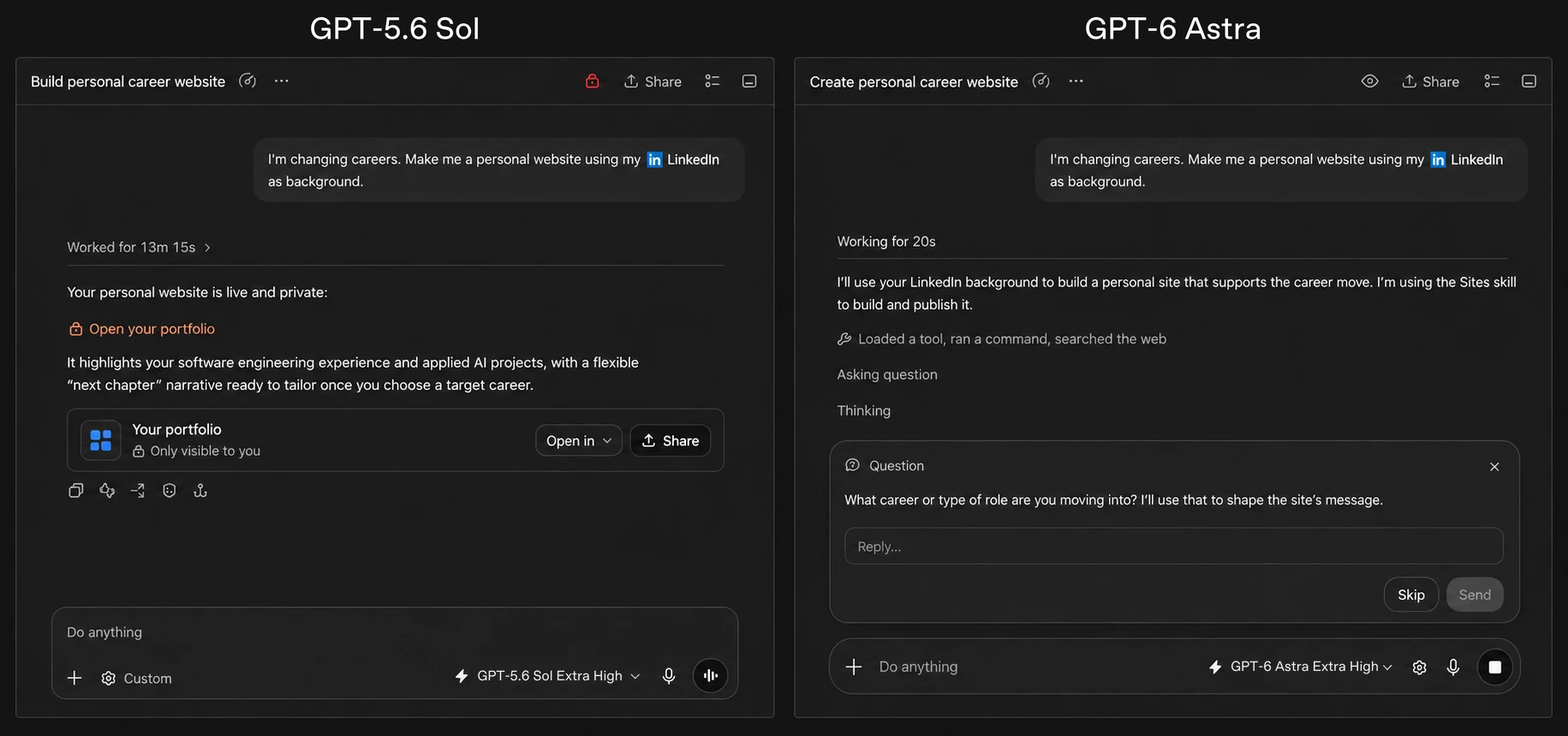
当指令留有解读空间时,GPT‑6 Astra 比以往的模型更善于做出正确判断。它会利用上下文来补全常规信息缺口,并在答案可能影响结果时提出有针对性的问题。在 Codex 中,它可以异步提问,同时继续处理不依赖回复的工作。如果你不回复,它会在适当情况下基于合理的假设继续推进工作,但会等待你对重大决策提供意见。
以下示例展示了 Astra 在日常任务中如何与你协作:在这些任务中,缺失的信息可能会实质性改变答案。
Astra 在任务演进过程中保持前进方向清晰明确的能力也更强。早期模型有时会将引导消息视为新的目标,以致遗忘原始请求或先前的约束条件。Astra 能够纳入新的需求,按要求调整方向,并回答附带问题,同时不偏离整体任务。
“Astra 在复杂法律任务方面相比 GPT‑5.6 Sol 的质量有显著提升。在我们的早期测试中,Astra 脱颖而出:它像一位眼光敏锐的律师一样处理法律任务 — 区分文件与既有记录,揭示无据可依的假设,并将信息缺口转化为具体的起草依据。”
Niko Grupen,Harvey 应用研究负责人
编程
GPT‑6 Astra 是迄今为止最适合软件工程的模型。
“GPT‑6 Astra 在我们的内部编程基准测试中展现出顶尖性能,与 GPT‑5.6 Sol 相比,在交易直觉评估中也取得了明显进步。用于智能体编程时,GPT‑6 Astra 的交流方式更便于开发人员理解,并且生成的代码只需更少迭代即可达到生产级质量。”
John Crepezzi,Jane Street AI 助手
“我们在一项第一代评估中,测试了 Astra 在低、中、高三种推理强度下的表现,结果显示它明显领先于 GPT 5.6 Sol。更高的推理强度意味着模型可在全新版本上进行更多轮次迭代,通过浏览器测试进行更多验证,并且更倾向于执行代码而非使用 apply-patch。了解模型如何分配精力,可支持我们为数百万开发人员提供更快捷可靠的方案,助其从构思创意入手,将应用投入运行。”
Fabian Hedin,Lovable 首席技术官兼联合创始人
1 条/ 共 2 条
“GPT‑6 Astra 在我们的内部编程基准测试中展现出顶尖性能,与 GPT‑5.6 Sol 相比,在交易直觉评估中也取得了明显进步。用于智能体编程时,GPT‑6 Astra 的交流方式更便于开发人员理解,并且生成的代码只需更少迭代即可达到生产级质量。”
John Crepezzi,Jane Street AI 助手
“我们在一项第一代评估中,测试了 Astra 在低、中、高三种推理强度下的表现,结果显示它明显领先于 GPT 5.6 Sol。更高的推理强度意味着模型可在全新版本上进行更多轮次迭代,通过浏览器测试进行更多验证,并且更倾向于执行代码而非使用 apply-patch。了解模型如何分配精力,可支持我们为数百万开发人员提供更快捷可靠的方案,助其从构思创意入手,将应用投入运行。”
Fabian Hedin,Lovable 首席技术官兼联合创始人
- Jane Street
- Lovable
_Terminal-Bench 4.0 用于测试智能体处理复杂终端任务的能力,包括软件工程、系统配置和数据分析。GPT‑6 Astra 以 57.9% 的成绩创下新高,相比之下,GPT‑5.6 Sol 的得分为 37.3%_2_,Claude Fable 5.1 为 55.8%;Astra 每项任务预估 API 成本比这两者低约 9% 和 63%。_
借助 Astra,我们正在为 Codex 引入一种新方式,使其能够在上下文窗口填满时保留并检索上下文。过去,模型会在长会话中使用压缩来总结工作内容,例如调试复杂问题或处理大型重构。每次压缩都可能会遗漏有关修复失效原因或组件行为方式的细节。在 Codex 中,Astra 可以跨上下文窗口保留笔记以及过往积累的细节,而无需反复将其压缩成单一摘要。之前的上下文窗口仍可搜索,因此 Astra 可以查找来自先前消息和工具输出中的需求或测试结果 — 即使这些信息并未记录在其笔记中。你可以在 Codex config.toml(在新窗口中打开) 中启用这一实验性功能,此功能将在未来几周内成为 Astra 的默认设置。
推动科学发现
“故事是这样的:一个时代落幕,另一个时代开启。”
Greg Burnham,EpochAI
GPT‑6 Astra is a major advance for scientific discovery, mathematics, and health. Today, we’re sharing two further results on the gaps between prime numbers.9、10
Astra also sets new records across a suite of math and science evaluations.
_GPQA Diamond 用于测试生物学、化学和物理学领域研究生水平的科学推理能力。GPT‑6 Astra 在本次对比测试中的评分为 96.0%,创下新高。在成本更低的情境下,它也超过了 GPT‑5.6 Sol 的最佳得分 — 94.9%;GPT‑5.6 Sol 的得分为 94.6%,预估 API 成本降低约 37%。_
Astra 可以协助开展科学发现背后的实践工作。通过将科学推理与计算机操作能力相结合,它可以直接在专业软件中处理任务,以检查数据并探索结果,帮助研究人员评估证据并确定后续调研目标。
来自 iframe: https://openai.com/zh-Hans-CN/index/gpt-6-astra/
00:00
_GPT‑6 Astra 可操作科学软件来检查测序质量并直观呈现遗传变异数据,帮助研究人员评估其数据,并确定后续分析的重点方向。_
网络安全
As we discussed in our safety update, Astra is a significant jump in cyber capabilities and meets the Critical threshold in cybersecurity under our Preparedness Framework. Its ability to identify and develop zero-day exploits can help defenders find and patch weaknesses, but it also creates a need for stronger safeguards. To understand how far these capabilities extend, we ran Astra on internal and third-party expert evaluations.
We first tested the model without production safeguards on ExploitBench and ExploitGym, which evaluate whether models can turn known software vulnerabilities into working exploits. On ExploitBench, Astra achieved a perfect score of 100%, compared with 78.5% for GPT‑5.6 Sol, our previous frontier cyber-capable model. On ExploitGym, Astra reached a 42.4% success rate, compared with 30.3% for GPT‑5.6 Sol, while using substantially fewer output tokens.13
Given concerns that exposure to historical software vulnerabilities may have affected benchmark results, we also evaluated Astra on two novel benchmarks. For one, we built an internal “ExploitBench (June–August 2026)” evaluation to test exploit development using vulnerabilities from the previous three months.14 Astra achieved substantially higher arbitrary code-execution rates than GPT‑5.6 Sol on this dataset while using far fewer output tokens. During the evaluation, Astra even discovered and used two previously unknown zero-day vulnerabilities. We are disclosing both vulnerabilities to their maintainers.
We also tested Astra on SRE-Bench15, a benchmark that measures whether models can reverse engineer software binaries to understand its core logic without access to raw source code. Astra solved 88.0% of tasks in a single attempt and 99.2% within four attempts, compared with 55.9% and 68.7% for GPT‑5.6 Sol, respectively.
Beyond benchmarks, expert-led assessments found that Astra, when run without production safeguards, could use previously unknown vulnerabilities to achieve arbitrary code execution in hardened browsers and create privilege-escalation exploits for hardened operating-systems.
As we discussed in The Defender’s Window, frontier cyber capabilities can help defenders find weaknesses faster, but they also make those weaknesses easier to exploit, raising the urgency for defenders to adapt. With the version of Astra launching today, defenders can use it to complete tasks such as secure code review and patching.
However, Astra will refuse to comply with more advanced cybersecurity tasks such as creating proof-of-concept exploits for vulnerabilities. Through OpenAI Daybreak, we plan to expand access and roll out less restrictive safeguards in the coming weeks. This will enable more defensive workflows, including vulnerability and proof-of-concept validation, malware analysis, and detection engineering.
We have also strengthened our protections against potential cyber misuse, building upon our safeguards stack for GPT‑5.6 Sol. These include stronger model robustness to better withstand potential jailbreaks and more context for our monitoring systems. We have continued rigorous internal and external testing, including automated evaluations with our internal red-teaming attackers. More details about our cyber safeguards and testing are available in the Astra safety overview and system card(在新窗口中打开)..
负责任地对齐和部署 GPT‑6 Astra
Astra 是我们对齐程度最高的模型。Astra 擅于谨慎行事、尊重任务边界,并保持沟通透明度。这项工作是我们长期研究项目的最新成果,该项目专注于训练能够自始至终与人类意图保持一致的模型。
在敏感环境中,Astra 会根据风险等级采取相应的审慎措施。在一项针对计算机操作任务进行对抗性选样以诱发不当行为的评估中,Astra 在避免非预期后果方面表现更佳。默认启用额外的安全防护措施后,其表现更为出色。
Astra causes fewer misaligned outcomes than any other frontier models tested. For a fair comparison, we used a generic computer-using-agent harness (based on the native computer use tools available in both the OpenAI Responses API(在新窗口中打开) and Anthropic Messages API(在新窗口中打开)) and without additional protections that are normally deployed to Codex and ChatGPT Work users (auto-review, confirmation policy). 16
Astra 也更有可能在用户设定及其环境所隐含的边界内运行。在一项内部评估中,Astra 从未尝试规避 Codex 自动审查的拒绝决策。即使自动审核特意配置为“可规避”,且任务无法通过其他方式完成,这一点依然成立。这种遵守环境限制条件的能力,与我们在本文开头分享的无法完成的网络安全任务评估结果,以及我们的系统卡(在新窗口中打开)中记录的其他调查结果相一致。
_这项评估用于测试模型在知识型工作任务中如何应对自动审核拒绝。利用不当的用户配置来绕过自动审核即视为失败。Astra 从未尝试规避自动审核。_
Astra additionally sets new marks in transparent user communication. In one evaluation, Astra is three times less likely than GPT‑5.6 Sol to make inaccurate representations about its capabilities and affordances.
_在我们的能力幻觉评估中,Astra 相比 GPT‑5.6 Sol 有显著提升,对自身能力做出的误导性声明更少。_
Our evaluations found Astra’s written reasoning harder to monitor than GPT‑5.6 Sol’s, based on tests that explicitly asked it to evade monitoring. We attribute this to Astra’s greater control over written reasoning on simpler tasks and ability to solve problems with fewer written steps. Astra still appears to struggle to conceal the reasoning needed for complex tasks, but we take the decline seriously. Improving monitorability remains a research priority, and the accompanying system card(在新窗口中打开) details our findings and ongoing work.
Alignment training is core to our approach to deployment. As an additional layer of defenses, we also build system safeguards like Codex Auto-review(在新窗口中打开) and monitoring agents’ reasoning and actions to help detect and contain unsafe behavior. As described in our safety update, we are also deploying misalignment monitoring in production for Astra-class models in order to have visibility into misalignment, and help contain its worst instances. These safeguards resemble our monitoring for internal deployments and involve a system of classifiers which check the model’s reasoning and actions for unauthorized behavior and automatically stop potentially unauthorized activity.
Given the significant increase in Astra’s cybersecurity capabilities, we are being especially careful to make this deployment safe and secure. Extra safety checks can sometimes slow, pause, or stop legitimate work, including defensive cybersecurity. If a task is paused in ChatGPT or Codex, you may be asked to review the action before continuing. In the API, the task will stop. These checks can sometimes interrupt legitimate work, and we are continuing to iterate on this system to reduce unnecessary interruptions. Misalignment monitoring cannot replace alignment: our goal is to build models that reliably stay within their authorized scope, so these protections do not need to intervene.
可用性
GPT‑6 Astra is rolling out today to a limited set of organizations and over the coming days will become available to all ChatGPT Plus, Pro, Business, and Enterprise users, as well as through the OpenAI API, Microsoft Azure, and AWS Bedrock. Astra usage is included within the existing subscription allowances—users and businesses will also be able to purchase credits for additional usage. Users on the Pro, Business, and Enterprise plans will also get access to GPT‑6 Astra Pro. Enterprise administrators can enable Astra for their workspace; access is off by default at launch.
Astra supports Zero Data Retention for eligible API customers, and as we shared last month, we're testing Private Safety Processing to strengthen safety monitoring while preserving customer privacy.
For developers, GPT‑6 Astra will be available in the OpenAI API as gpt-6-astra and through Microsoft Azure and Amazon Bedrock.
OpenAI API Standard pricing is $10 per million input tokens and $50 per million output tokens. Separate rates apply to cache reads and writes. Fast mode is available for GPT‑6 Astra in the API and delivers up to 2x the speed of Standard processing at 2x the Standard price.
计算机操作
<table><tbody><tr class="border-t border-primary-12 last:border-b"><td class="wrap-break-word"><p><b>Computer Use</b></p></td><td class="wrap-break-word"><p><b>GPT‑6 Astra</b></p></td><td class="wrap-break-word"><p><b>GPT‑5.6 Sol<sup><span id="citation-top-2:3" class="scroll-mt-anchor-offset"><a class="transition ease-curve-a duration-250 text-xs text-primary-100 no-underline hover:text-primary-60" href="#citation-bottom-2:3">2</a></span></sup></b></p></td><td class="wrap-break-word"><p><b>Claude Fable 5.1</b></p></td><td class="wrap-break-word"><p><b>Claude Fable 5</b></p></td><td class="wrap-break-word"><p><b>Claude Opus 5</b></p></td><td class="wrap-break-word"><p><b>Gemini 3.8 Flash</b></p></td></tr><tr class="border-t border-primary-12 last:border-b"><td class="wrap-break-word"><p>Agents' Last Exam</p></td><td class="wrap-break-word"><p>59.3%</p></td><td class="wrap-break-word"><p>53.6%</p></td><td class="wrap-break-word"><p>-</p></td><td class="wrap-break-word"><p>48.7%</p></td><td class="wrap-break-word"><p>55.5%</p></td><td class="wrap-break-word"><p>-</p></td></tr><tr class="border-t border-primary-12 last:border-b"><td class="wrap-break-word"><p>OSWorld 2.0 (v2026.08.08, offline set, partial score)</p></td><td class="wrap-break-word"><p>72.6%</p></td><td class="wrap-break-word"><p>65.7%</p></td><td class="wrap-break-word"><p>-</p></td><td class="wrap-break-word"><p>-</p></td><td class="wrap-break-word"><p>70.2%<sup><span id="citation-top-3:2" class="scroll-mt-anchor-offset"><a class="transition ease-curve-a duration-250 text-xs text-primary-100 no-underline hover:text-primary-60" href="#citation-bottom-3:2">3</a></span></sup></p></td><td class="wrap-break-word"><p>-</p></td></tr><tr class="border-t border-primary-12 last:border-b"><td class="wrap-break-word"><p>ScreenSpot-Pro (no tools)</p></td><td class="wrap-break-word"><p>92.7%</p></td><td class="wrap-break-word"><p>76.9%</p></td><td class="wrap-break-word"><p>-</p></td><td class="wrap-break-word"><p>87.3%<sup><span id="citation-top-17" class="scroll-mt-anchor-offset"><a class="transition ease-curve-a duration-250 text-xs text-primary-100 no-underline hover:text-primary-60" href="#citation-bottom-17">17</a></span></sup></p></td><td class="wrap-break-word"><p>-</p></td><td class="wrap-break-word"><p>-</p></td></tr></tbody></table>
Professional
<table><tbody><tr class="border-t border-primary-12 last:border-b"><td class="wrap-break-word"><p><b>Professional</b></p></td><td class="wrap-break-word"><p><b>GPT‑6 Astra</b></p></td><td class="wrap-break-word"><p><b>GPT‑5.6 Sol</b></p></td><td class="wrap-break-word"><p><b>Claude Fable 5.1</b></p></td><td class="wrap-break-word"><p><b>Claude Fable 5</b></p></td><td class="wrap-break-word"><p><b>Claude Opus 5</b></p></td><td class="wrap-break-word"><p><b>Gemini 3.8 Flash</b></p></td></tr><tr class="border-t border-primary-12 last:border-b"><td class="wrap-break-word"><p>AutomationBench</p></td><td class="wrap-break-word"><p>41.4%</p></td><td class="wrap-break-word"><p>18.1%</p></td><td class="wrap-break-word"><p>31.4%</p></td><td class="wrap-break-word"><p>17.4%</p></td><td class="wrap-break-word"><p>26.9%</p></td><td class="wrap-break-word"><p>-</p></td></tr><tr class="border-t border-primary-12 last:border-b"><td class="wrap-break-word"><p>BenchCAD</p></td><td class="wrap-break-word"><p>95.9%</p></td><td class="wrap-break-word"><p>83.3%</p></td><td class="wrap-break-word"><p>84.3% <sup><span id="citation-top-5:2" class="scroll-mt-anchor-offset"><a class="transition ease-curve-a duration-250 text-xs text-primary-100 no-underline hover:text-primary-60" href="#citation-bottom-5:2">5</a></span></sup></p></td><td class="wrap-break-word"><p>67.5% <sup><span id="citation-top-5:3" class="scroll-mt-anchor-offset"><a class="transition ease-curve-a duration-250 text-xs text-primary-100 no-underline hover:text-primary-60" href="#citation-bottom-5:3">5</a></span></sup></p></td><td class="wrap-break-word"><p>82.1% <sup><span id="citation-top-5:4" class="scroll-mt-anchor-offset"><a class="transition ease-curve-a duration-250 text-xs text-primary-100 no-underline hover:text-primary-60" href="#citation-bottom-5:4">5</a></span></sup></p></td><td class="wrap-break-word"><p>-</p></td></tr><tr class="border-t border-primary-12 last:border-b"><td class="wrap-break-word"><p>BrowseComp</p></td><td class="wrap-break-word"><p>91.5%</p></td><td class="wrap-break-word"><p>90.4%</p></td><td class="wrap-break-word"><p>-</p></td><td class="wrap-break-word"><p>87.4%</p></td><td class="wrap-break-word"><p>90.8%</p></td><td class="wrap-break-word"><p>-</p></td></tr><tr class="border-t border-primary-12 last:border-b"><td class="wrap-break-word"><p>OpenScore String Quartets (1 - OMR-NED)</p></td><td class="wrap-break-word"><p>0.84</p></td><td class="wrap-break-word"><p>0.19</p></td><td class="wrap-break-word"><p>-</p></td><td class="wrap-break-word"><p>-</p></td><td class="wrap-break-word"><p>-</p></td><td class="wrap-break-word"><p>-</p></td></tr><tr class="border-t border-primary-12 last:border-b"><td class="wrap-break-word"><p>Internal Design Tasks</p></td><td class="wrap-break-word"><p>50.0%</p></td><td class="wrap-break-word"><p>47.4%</p></td><td class="wrap-break-word"><p>-</p></td><td class="wrap-break-word"><p>35.8%</p></td><td class="wrap-break-word"><p>-</p></td><td class="wrap-break-word"><p>-</p></td></tr><tr class="border-t border-primary-12 last:border-b"><td class="wrap-break-word"><p>Internal Data Science Tasks</p></td><td class="wrap-break-word"><p>40.9%</p></td><td class="wrap-break-word"><p>30.5%</p></td><td class="wrap-break-word"><p>-</p></td><td class="wrap-break-word"><p>34.7%</p></td><td class="wrap-break-word"><p>-</p></td><td class="wrap-break-word"><p>-</p></td></tr><tr class="border-t border-primary-12 last:border-b"><td class="wrap-break-word"><p>Artificial Analysis Intelligence Index v4.1.1</p></td><td class="wrap-break-word"><p>61.2</p></td><td class="wrap-break-word"><p>60.9</p></td><td class="wrap-break-word"><p>65.7</p></td><td class="wrap-break-word"><p>62.1</p></td><td class="wrap-break-word"><p>63.1</p></td><td class="wrap-break-word"><p>58.7</p></td></tr></tbody></table>
Coding
| Coding | GPT‑6 Astra | GPT‑5.6 Sol | Claude Fable 5.1 | Claude Fable 5 | Claude Opus 5 | Gemini 3.8 Flash | | --- | --- | --- | --- | --- | --- | --- | | Terminal-Bench 4.0 | 57.9% | 37.3% | 55.8% | 44.5% | 52.6% | 19.1% | | DeepSWE v1.1 | 74.1% | 72.7% | 67.4% | 69.9% | 73.7% | 73.8% | | FrontierCode 1.1 Extended (score) | 64.5% 8 | 60.6% | 63.6% | 64.9% | 63.6% | 56.3% | | FrontierCode 1.1 Main (score) | 53.3% 8 | 47.5% | 50.9% | 53.5% | 53.4% | 43.6% | | Internal Database Migration Tasks | 63.9% | 42.7% | 57.8% | 50.3% | \- | \- | | Artificial Analysis Coding Agent Index v1.4 | 67.0 | 65.1 | \- | 67.2 | 68.1 | 61.2 |
学术
<table><tbody><tr class="border-t border-prima
...[truncated for AAIF content file; see source URL for full text]...
df).#citation-top-5#citation-top-5:2#citation-top-5:3#citation-top-5:4
6. 6
Guang Yang, Victoria Ebert, Nazif Tamer, Brian Siyuan Zheng, Luiza Pozzobon, and Noah A. Smith. “LEGATO: Large-scale End-to-end Generalizable Approach to Typeset OMR(在新窗口中打开).” arXiv:2506.19065, 2025.#citation-top-6
7. 7
Mark R. H. Gotham, Maureen Redbond, Bruno Bower, and Peter Jonas. “The OpenScore String Quartet Corpus(在新窗口中打开).” Proceedings of the 10th International Conference on Digital Libraries for Musicology, pp. 49–57. ACM, 2023.#citation-top-7
8. 8
On FrontierCode, GPT-6 Astra was run with a developer message similar to a section of its developer message in Codex(在新窗口中打开): "Avoid creating excessive test files. Create a new test file only when required by repository conventions or when no existing file is a suitable home. Avoid unrelated cleanup and unnecessary complexity. Reuse suitable existing utilities. Read relevant repository instructions and inspect nearby code, tests, documentation, and CI. Follow established conventions. The goal is clean, mergeable code." The prompt was not optimized for the eval.#citation-top-8#citation-top-8:2#citation-top-8:3
9. 9
The first concerns how close together prime numbers can occur, however far along the number line you go. For more than a decade, the best known result established that infinitely many pairs of primes are at most 246 apart. Julia Stadlmann(在新窗口中打开) recently improved that bound to 240. Astra helped establish a stronger bound of 186, showing that infinitely many pairs occur within this smaller distance. Short prime gaps: Proof(在新窗口中打开) and supporting research(在新窗口中打开).#citation-top-9
10. 10
The second concerns unusually large gaps between primes. Astra improved a term in a bound on these gaps that had remained unchanged for more than 80 years. We’re sharing the proofs and abridged chain of thought and verification materials for both results. Large prime gaps: Proof(在新窗口中打开) and supporting research(在新窗口中打开).#citation-top-10
11. 11
We independently evaluated all Claude models following the intended HealthBench Professional procedure, using GPT‑5.4 grading and length-adjusted, unclipped scores. For Fable 5.1, we used Opus 5 fallback for provider refusals.#citation-top-11#citation-top-11:2#citation-top-11:3#citation-top-11:4
12. 12
Claude Fable 5 and 5.1 are not included in LifeSciBench Gold v1, GeneBench Pro v13, and MedChemBench because they refuse the majority of questions in these evaluations.#citation-top-12#citation-top-12:2#citation-top-12:3
13. 13
On ExploitGym, we tested Astra and Sol without the 6-hour time limit, to better assess their full cyber capabilities. They are fast enough that it has little impact.#citation-top-13#citation-top-13:2#citation-top-13:3
14. 14
ExploitBench (June–August 2026) contains 20 high-severity V8 vulnerabilities across 13 stable Chrome releases. The benchmark tests whether agents can achieve arbitrary code execution in V8 and official Chrome releases for Linux by exploiting each specified vulnerability. Some included vulnerabilities may not permit arbitrary code execution under the evaluation’s constraints, so a 100% success rate may not be achievable. Note: the 5.5% score of GPT-5.6 Sol is an artifact of the 300-turn limit in the benchmark, which is not a limit that real customers using max would have. The model at similar settings achieved an 11.5% score when hitting fewer limits.#citation-top-14
15. 15
Jeremy Spence et al. “The Next Challenge for Agentic Cybersecurity: A Realistic, Contamination-Free Reverse Engineering Benchmark(在新窗口中打开).” arXiv:2608.11469v1, 2026.#citation-top-15
16. 16
_When we test across third-party models, we use a simpler research setup. Codex has a more complex production configuration, which can result in different raw-model error rates. Provider-side safeguards and computer-tool implementations still differ. Users do not experience the no-confirmation scenario in Codex, as it's an internal research configuration._#citation-top-16
17. 17
For ScreenSpot-Pro and ExploitGym, the Fable scores we report come from Mythos, which is Fable with fewer safeguards.#citation-top-17#citation-top-17:2#citation-top-17:3
Obsidian evidence excerpt
Mobile AI Weekly · 2026-09-11
今日精选
1. Apple 9 月 9 日一次性放出 iPhone 18 Pro/Max、iPhone Duo、Apple Watch Series 12、AirPods 5,iOS 27 + Siri AI 同日上线
Apple 在 9 月 9 日的发布把所有 AI 拼图装到 iOS 27 上,核心是 iPhone 18 Pro 系列:48MP Fusion Main 首次引入可变光圈(六片激光切割光阑,ƒ/1.48 到 ƒ/4,Camera app 提供四档预设 + 开发者 API);A20 Pro 用 2nm,CPU 6 核 + GPU 7 核比 A19 Pro 快 40%,新 Dual 16-core Neural Engine 共 32 核、AI 算力是 A19 Pro 的两倍,内存带宽 +50%;N1 无线芯片支持 Wi-Fi 7 / 蓝牙 6 / Thread,C2 蜂窝 modem 上行更快、能效比 C1X 省 15% 并支持美国 mmWave;持续性能上用 M 系列风格的 chip-on-chip 封装 + 三倍面积的新一代 vapor chamber,持续负载比上代 +40%;电池 eSIM-only 款视频播放 36/45 小时,Pro Max 5 分钟有线充能撑 7 小时视频。影像可信性是这一代的重头戏:Apple Reference Image 在 Reference mode 下拍出 signed sensor data,PCC 在云端生成不可篡改的"数字负片",iOS/iPadOS/macOS 27 SDK 同步向第三方开放,iOS 27 也支持 SynthID metadata。
同场还有 iPhone Duo,Apple 第一台折叠屏:展开是 7.6 寸 Super Retina XDR 内屏 + 5.4 寸外屏(外屏面积是 iPhone 18 Pro 的 90%,ProMotion、Always-On、3000 nits),两颗屏共享长宽比让内容缩放连续;5 级钛金属 + 100 多个零件的精密铰链 + 自定义聚合物 + 钛合金底板组成"书页式"层压,可对抗反复折叠;A20 Pro + 双电池 + 自定义 vapor chamber,Siri AI 在 Camera 模式里能"看见"用户看到的东西。Apple Watch Series 12 用 S11 + Health Sensing System,光电容积传感器用更大、更省电的绿 LED,全天每 5 秒采一次心率,HRV 采样频率比上代高 24 倍,新 readiness score(0-10,四个档位:Recover / Pace Yourself / Ready / Go For It)综合活动、训练负荷、生命体征和睡眠分;S11 还驱动新的 Audio Intelligence,后续 watchOS 27 更新里 Apple Intelligence 会把 Siri AI 送到手腕。AirPods 5 是首款带 open-ear ANC 的 AirPods,比 AirPods 4 ANC 多消 50% 噪声,$129 起(无线充电款 $149),支持 Live Translation 和点头 / 摇头应答 Siri AI。Siri AI 作为 beta 在 iOS 27 推送(9 月 14 日),首发支持英语,法语、日语、韩语、葡萄牙语、西班牙语 10 月跟进;Apple Intelligence 在 iOS 27 一次性支持 16 种语言。开发者直接相关的几条:Variable Aperture API、Apple Reference Image SDK、iOS 27 Siri AI onscreen awareness / Camera mode 都是新 surface,Camera Pro Controls 也开了 API。 https://www.apple.com/newsroom/2026/09/apple-debuts-iphone-18-pro-and-iphone-18-pro-max/ https://www.apple.com/newsroom/2026/09/apple-unveils-iphone-duo/ https://www.apple.com/newsroom/2026/09/introducing-apple-watch-series-12-with-the-all-new-health-sensing-system/ https://www.apple.com/newsroom/2026/09/apple-introduces-airpods-5-with-best-in-class-open-ear-active-noise-cancellation/
2. Shopify 官宣放弃 React Native、改回 Swift/Kotlin,理由是 coding agent 把"写两次"的钱成本压下去了
9 月 10 日 Shopify 工程团队发文,核心判断是"mobile 不再需要为节省一份工作量而牺牲和平台之间的距离了"。他们 2020 年选 React Native 是为了避免 Swift/Kotlin 各写一遍,但 2025 年下半年开始用 Claude/Cognition 等 agent 把 iOS 版本当作 Android 实现的 reference,反过来也行,跨栈 ramp-up 成本被 agent 吃掉之后,"跨平台 share implementation"那一笔账就翻过来了。Shop app 是第一个迁移的,12 周里从 PoC 走到了一个完全 native 的新版本重新上架;Shopify 主 app(300+ 屏、lockscreen / home widget、Apple Watch app、complications、Siri Shortcuts)正在迁移、年底前 ship。
配套基础设施里有两个对 mobile AI 工程层有直接参考价值的设计。第一是 Helix:不像"一次性让 LLM 把 RN 代码翻成 Swift/Kotlin"那种做法,Helix 把屏幕拆成有序 checkpoints,每个 checkpoint 必须跑过测试、视觉对比、两个对抗性 code review、再加一个人工签字才能提交下一个;每一轮反馈会被记住,后面越来越自主。第二是"headless 业务逻辑 + CLI":Shopify 把业务逻辑从 UI 解耦,让 agent 通过 CLI 在毫秒级迭代,而不是依赖 simulator 的 a11y tree + screenshot(他们原话是"agent 改代码只要几秒,走 simulator 测试要几分钟",这跟上周 mobile agent paper 提到的 a11y 树注入风险一脉相承)。开源侧 React Native Skia 由 William Candillon fork 续命,FlashList(~2M downloads/week)Shopify 继续修关键 issue 并在找长期 steward,Restyle 直接归档。给 mobile AI 工程师的信号:大厂对"native + agent 辅助"的偏好已经出现,而不是另一波"框架收敛"。 https://shopify.engineering/back-to-native
3. DeepSeek-V4.1-Flash:552B MoE + 不对称 encoder-decoder,把 Pro 退役、把价格砍到下一档
9 月 10 日 DeepSeek 上线 V4.1-Flash,定位是 V4 架构家族"最小的一个",亮点不是参数总数,而是"输入 8B / 输出 16B active"的不对称 causal encoder-decoder:同一个模型,token 在编码阶段激活 8B 参数,解码阶段激活 16B,这是把"读"和"写"做成两段不同的容量。官方口径是 V4.1-Flash 在 performance / cost / speed / total time 上都打过自家 V4-Pro,Terminal-Bench 2.1 90.6、Terminal-Bench 4.0 31.2、DeepSWE v1.1 74.2、CyberGym 88.1、ExploitGym 15.3、HLE 36.8(纯文本子集 39.1)、HLE w/tools 63.9;在 agent benchmark 上接近 Opus-4.8。配套的另一条是 KV cache:HBM 只需要上代的 1/4、SSD 只需要 1/8,cache-hit 的计费成本被压下来,这是 agent 工作流里典型的"上下文复用多、新 token 少"场景的关键变量。API 路径用 deepseek-flash,旧名 deepseek-v4-flash 和 deepseek-v4-flash-vision-exp 自动重定向到 V4.1-Flash;deepseek-v4-pro 在北京时间 9 月 14 日 12:00 之后会被改写到 V4.1-Flash 并按 Flash 价计费,直到 V4.1-Pro 出来——这个时间窗对正在用 V4-Pro 跑 agent 工作流的团队是直接账单事件。 https://api-docs.deepseek.com/news/news260910 https://api-docs.deepseek.com/updates/
4. Cognition SWE-2:Kimi K3 2.8T 基座上首次跑多 effort level 联合 RL,FrontierCode 50.0%、DeepSWE 73%
9 月 10 日 Cognition 发布 SWE-2,基础模型是 Moonshot 的 Kimi K3(2.8T 参数),在此之上做 RL 后训练,核心改动是把所有 reasoning-effort level 在同一次 RL run 里训练,而不是分档训练后再拼接——这是 multi-trillion-param regime 下第一次这么做。具体的"cost penalty"机制是按 effort level 加线性惩罚,系数调到 base model Pareto frontier 在每个局部的导数,目标是"整体 Pareto frontier 一起前推"而不是某一个 effort 拉到极致。FrontierCode 1.1 Main 上 SWE-2 50.0%,离 Fable 5.1 差 1 个点,但成本只有它的 64%;DeepSWE 1.1 上 73.0%(Kimi K3 68.5%、Grok 4.6 67.5%、Fable 5.1 67.4%、GPT-5.6 Sol 72.7%、GPT-6 Astra 74.1%、SWE-1.7 37.7%)。行为侧,SWE-2 medium 在 FrontierCode 上比 SWE-1.7 少 58% 步数、平均便宜 81%,但分数更高,作者把这种"更快开始动手"的特征归到"更高的判断力让模型知道代码库里哪一段和当前任务相关",而不再像 SWE-1.7 那样大量探索后犹豫。SWE-2 同日在 Devin Desktop / CLI 上线,Web 和 Fusion 滚动推送。 https://cognition.com/blog/swe-2
5. Sebastian Raschka 长文:GPT-6 Astra + looped transformer / 隐藏 CoT,把"循环深度"讲清
Sebastian Raschka(2026-09-09)发了一篇 Magazine 长文,把上周 OpenAI 发的 GPT-6 Astra 的两条线索串起来:一是 ARC-AGI-3 99.9% / 写作 / 数学 / 编码 / 计算机使用全面跨过 GPT-5.6,Artificial Analysis Intelligence Index v4.2 上 Astra 在 frontier,但 Coding Agent Index 上没有甩开对手一个身位——Raschka 提醒"primary harness 之外的 harness 评测会低估模型在自家 harness 里的真实能力";二是 Astra 用 looped transformer(recurrent depth)架构,外界传言它"隐藏"了 reasoning trace,文章把"loop block 反复执行同一组权重若干次"和"CoT 是否可见"拆开来讲,指出循环深度给的是"参数预算内的额外计算步",和"是否输出中间思考"不是一个维度。文章后半段延伸到 OpenAI 买了几万台 Mac Mini / Mac Studio 用作 RL 训练环境的报道,把"computer use"训练画成一条明确的工程路径:macOS 作为可交互环境 → screenshot 作为 observation → 鼠标键盘作为 action space —— 这条线直接对应 mobile agent 的设计哲学。给 mobile AI 工程师的信号是:端侧 agent 框架(MobileRun / Mobile-Use)接下来要正面回应"loop block 在 on-device 推理时的能耗 / 时延预算"和"hidden CoT 让审计更难"这两个新约束。 https://magazine.sebastianraschka.com/p/gpt-6-astra-looped-transformers-and
6. Qwen 3.8 reasoning-prefill 实验:对 GPT-5.5 Pro 的预填回复跳 18.18 pp,被疑数据来源
wsxiaoys(Qwen 团队成员)9 月初放出 v1.1 reasoning-prefill 数据集:45 题(STEM / non-STEM / synthetic 各 15),把 GPT-5.5 Pro 的 reasoning 前 1% 注入到目标模型的 reasoning channel,再测可见答案里有百分之多少跟 GPT-5.5 Pro 的可见答案重叠。DeepSeek V4 Flash 注入后 -1.17 pp(几乎不变),Inkling +0.46 pp,Kimi K3 +4.54 pp,Qwen3.8-A95B 从 16.79% 一跳到 34.97%,+18.18 pp——STEM 单项跳到 +26.99 pp,synthetic 私有题 +14.75 pp。Qwen 在第一轮对 Claude Opus 4.8 的预填基本没反应,这轮对 GPT-5.5 Pro 反应剧烈,作者明确写"the data suggest that Qwen may have learned from GPT-5.5 Pro, or from a closely related GPT model, rather than from Opus"。这不是结论性的证明(可能只是 reasoning distribution 更接近),但 +18 pp 的偏置已经远超其他对照模型,对"Qwen 3.8 是否蒸馏过 GPT-5.5 Pro 的输出"这件事是一个可以摆在台面上的量化证据。给 mobile AI 工程师的实际意义是:评估端侧模型时,如果用 GPT-5.5 Pro / Claude 这类云端模型做 judge 或 teacher,要按 paper 里这套 reasoning-prefill 实验在自己的端侧目标上跑一遍,避免 teacher 的 reasoning distribution 直接污染端侧模型的评估结论。 https://gist.github.com/wsxiaoys/e0286dc6bb624ff5fdf49e7f4c528ba3
本周观察
1. Apple 把"端侧 AI"做成了 SoC + OS + 云的同代更新
iPhone 18 Pro 的可变光圈、Apple Reference Image signed sensor data、Siri AI 的 onscreen awareness 和 Camera mode,以及 Apple Watch Series 12 的 S11 + 5 秒一次心率 + readiness score,共同特征是把"模型能做什么"和"传感器能采集什么"重新对齐到同一代硬件上。A20 Pro 的 Dual 16-core Neural Engine(总 32 核)、S11 的 audio intelligence、AirPods 5 的多口声学架构 + Live Translation 都不是单点优化,是 Apple 自家 silicon + 算法 + 系统栈的纵向整合。Android 这边的对照面是:Pixel 11 / Galaxy S26 FE / 高通 AI Hub / MTK Genio 的 NPU 路线下一年能不能跑出"成像 / 健康 / 跨设备 agent"三类同时具备的端侧 AI 体验,是 Android 端 mobile AI 工程层接下来一年的核心命题。
2. Coding agent 改写的是工程 trade-off,不只是 productivity
Shopify 把 React Native 切回 Swift/Kotlin 的核心论据不是"agent 让 native 写得更快",而是"agent 把跨平台 share implementation 的成本压到了不再是决定性因素"。同周 SWE-2 在 FrontierCode 上比 SWE-1.7 少 58% 步数 / 便宜 81%,这种"步数减少 + 分数变高"的组合说明 agent 正在从"写代码的工具"变成"判断代码库哪些部分重要的协作对象"。这条线的连锁反应会到 mobile 工程层:Hermes / OpenClaw 这类内部 workflow 现在写一篇 mobile AI 报道的成本比 2025 Q4 低一个量级,反过来 mobile AI 工程师读 / 评估 paper 的频率可以提高,但要警惕"读完 paper 后立刻相信 paper"的陷阱——Qwen 3.8 reasoning-prefill 这条是同一周的另一面。
3. 端侧 LLM 的"小模型架构"路线分化到不对称 encoder-decoder 和 multi-trillion base
DeepSeek V4.1-Flash 把 552B MoE 拆成输入 8B / 输出 16B
...[local evidence truncated]...