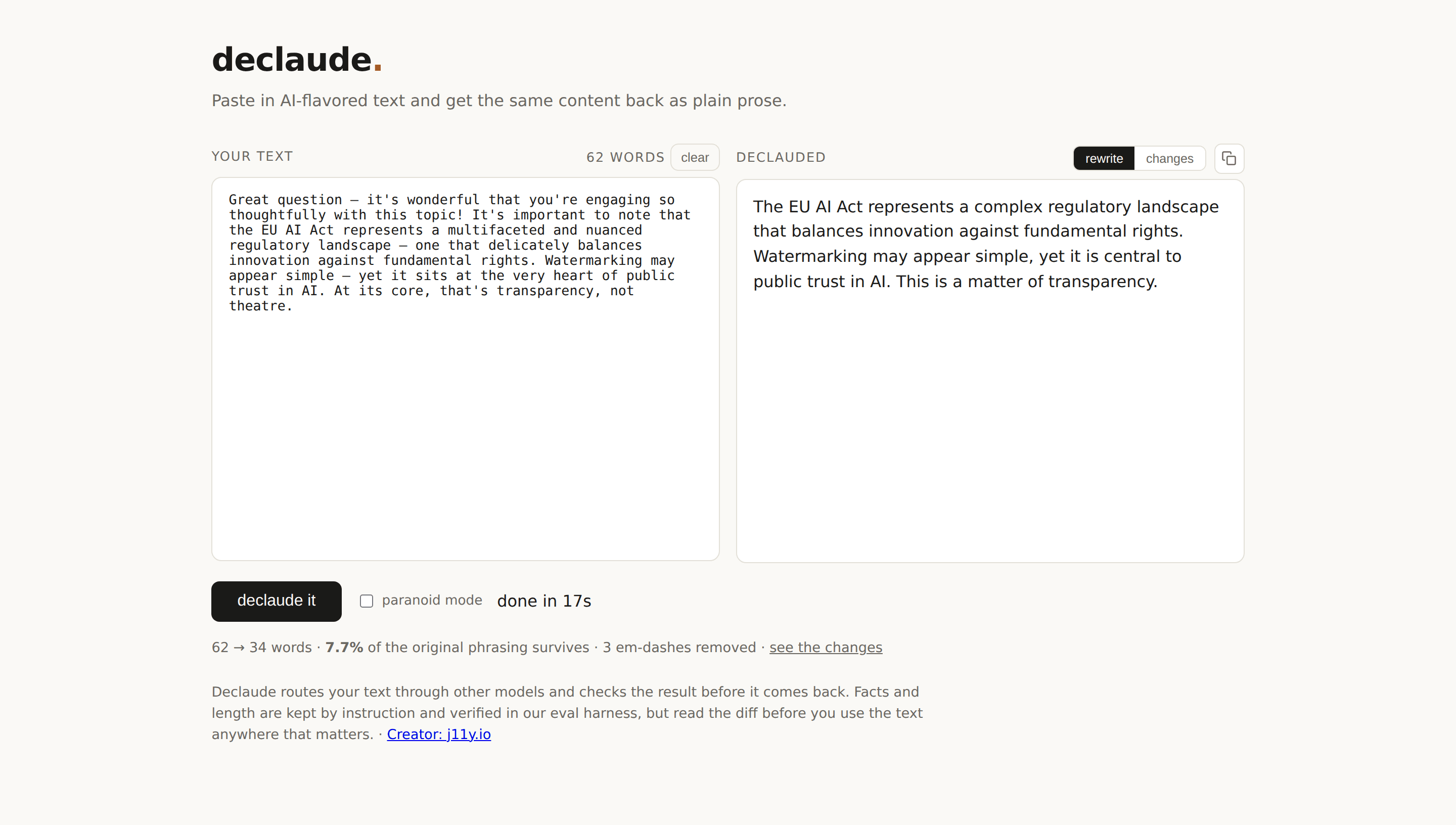
Anthropic’s weak watermarks appease a weak law
- ID: e0b3d633
- 原文链接: https://blog.j11y.io/2026-08-12_Anthropics-weak-watermarks-appease-a-weak-law/
- 作者: James Padolsey
- 日期: 2026-08-12
- 分类: industry
- 来源类型: article
- 标签: anthropic, watermark, eu-ai-act, declaude, regulation, synthid
- 质量评分: 4/5
- 抓取时间: 2026-08-17T23:51:34+08:00
中文导读
Padolsey 用交互式 essay 拆穿语义水印机制,并发布 Declaude——把 AI 文本重写到水印检测不出来。他的核心读法:EU AI Act 50(2) 对“辅助性标准编辑”的豁免本意是收窄范围,Anthropic 却选了模型级一刀切,比法律底线更宽。弱水印两头不讨好:会冤枉依赖 AI 辅助写作的残障与神经多样性用户,又挡不住有动机的充分重写。他还观察到 Claude 谈自家水印时明显比谈别家更谨慎。
为什么值得关注
水印技术最强的反向科普:附 Declaude 重写工具,证明弱水印既冤枉好人又防不住作弊者。
收录理由:附可运行的反制工具与交互式讲解,把语义水印的技术与社会两面同时讲穿
关键信息
- AK RSS Digest 评分:AK RSS Digest 评分:8.0/10
- 来源:AK RSS Digest(2026-08-17 期)
- Obsidian 证据:
OpenClaw定时任务/AK-RSS-Digest(89源精选)/2026-08-17-AK-RSS-Digest(89源精选).md
原文快照
Anthropic’s weak watermarks appease a weak law
2026-08-12
Anthropic’s weak watermarks appease a weak law
Anthropic announced in August 2026 that text generated by supported Claude models will carry invisible, machine-readable watermarks, applied at model level across supported Claude products and API surfaces worldwide. The move is Anthropic’s response to Article 50(2) of the EU AI Act, which requires providers to ensure that outputs are “marked in a machine-readable format and detectable as artificially generated or manipulated”. Yet the same provision exempts systems performing an “assistive function for standard editing”, or which do not substantially alter the user’s input or its meaning. This is a provider-side technical obligation, not a general requirement that every person using AI must visibly disclose it.
Anthropic concedes that the mark is not proof of authorship: Claude may merely have proofread, translated, summarised or otherwise processed human work, while substantial rewriting, paraphrasing, translation or mixing may make the mark disappear. It may survive copy-pasting and light editing. It is a hint of provenance, not a definitive detector.
I’m not against such provenance measures, nor against ensuring humans remain accountable to each other. And I don’t want cognitive decline due to AI replacing our prose-writing. However, I am quite against appeasing laws that are not truly efficacious, or rather, are efficacious only against people who are not technically sophisticated enough to circumvent them. Not only that, but in this case that is likely to correlate with those who have a higher need for AI-aided text. I wager this disproportionately includes disabled and neurodivergent individuals, or those in circumstances that afford them less time and capacity for the ordinary expenditure of cognitive effort involved in prose-writing.
That is to say: this rule risks penalising people who are already less able to produce conventional prose unaided for using technological means to make their lives easier. The Act exempts standard editing, but many legitimate assistive uses require more substantial rewriting while leaving the ideas, judgment and responsibility with the human. The same thought that led to this law could have applied to calculators at the time of their inception, had their outputs revealed themselves through artefacts. Thankfully, a sum borne of the brain is treated no differently from one produced by a calculator. Likewise with spellcheckers. To make assistance suspect only once the tool becomes capable enough to compose a whole sentence is not a principled boundary. It is a moral premium placed on difficulty itself.
Anthropic has nevertheless chosen a blanket, model-level implementation that appears broader than the law’s minimum req
抓取方式:opencli web read(2026-08-17)。完整原文见上方链接。