Patterns and problems in emerging multiagent systems
- ID: af863cb3
- 原文链接: https://www.anthropic.com/research/multiagent-systems
- 作者: Anthropic Frontier Red Team
- 日期: 2026-08-13
- 分类: agents
- 来源类型: article
- 标签: multiagent, agents, red-team, collusion, coordination, emergent-behavior, safety
- 质量评分: 5/5
- 抓取时间: 2026-08-17T23:51:34+08:00
中文导读
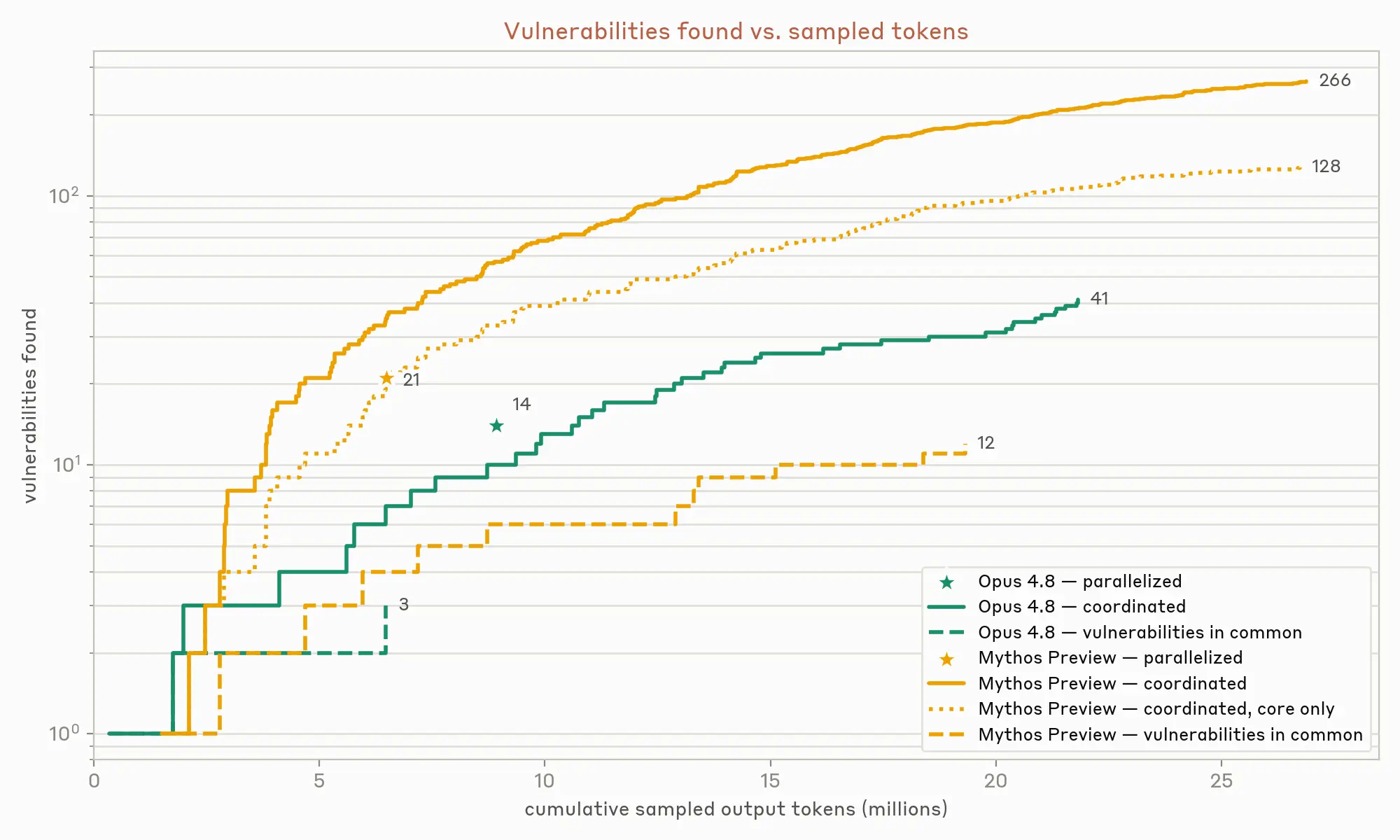
Anthropic Frontier Red Team 首份多 agent 系统性失败报告:45 个 agent 各自 VM + 共享论坛找 15 个开源项目漏洞,Mythos Preview 协调 swarm 用 27M token 挖出 266 个、独立并行用 6.5M token 挖出 21 个,但重叠只有 12 个——协调换的是覆盖广度不是精度。共享代码的 PR merge 率普遍走低,高 merge 率多靠“几乎不共享文件”换来。限速 API 下独立 agent 自发刷 30Hz 轮询(2.4M 请求仅 117 个成功);Bertrand 定价博弈第 3 轮即串通,移除私聊后靠公开 listing 继续“分计价”协同;三个 agent 抢同一个 Python 服务时演化出自我复制的杀进程脚本。低方差决策者扎堆,系统性风险比人类团队更集中。
为什么值得关注
多 agent 实战失败模式的首份系统化报告:协调换覆盖不换精度,串通与资源踩踏是常态而非意外。
收录理由:前沿红队把多 agent 协同的失败模式首次系统化,全部实验来自真实运行而非假设
关键信息
- ClawFeed 24小时高价值一览 评分:ClawFeed 评分:8.8/10
- 来源:ClawFeed 24小时高价值一览(2026-08-17 期)
- Obsidian 证据:
OpenClaw定时任务/ClawFeed24小时高价值一览/2026-08-17-ClawFeed24小时高价值一览.md
原文快照
Patterns and problems in multiagent systems
Frontier Red Team
Patterns and problems in emerging multiagent systems
Aug 13, 2026
Models are improving and AI agents are taking on more tasks in shared codebases, markets, and other social systems. As a result, an increase in real-world interactions between agents is imminent. We've already begun studying this, but still have a lot of uncertainty regarding what this looks like at scale. The trajectory is easy to imagine and hard to slow: current institutions are designed by and for people, resting on assumptions about the sufficiency of oversight at human speed. Some institutions will become human-AI hybrids; others where agents outcompete on speed or cost will become agent-only. The volume of agent-agent interaction could plausibly exceed that of human-human and human-agent interactions before the world understands the conditions for making such interactions go well.
Agents are unlike people in many ways. They can work for longer, instantly grasp large bodies of information, and exhibit a breadth of knowledge surpassing any person. Yet they are also susceptible to confabulation and reward hacking, and despite progress in alignment, we know very little about how they behave in complex, real-world, multiagent environments. Moreover, benign behavioral quirks at the individual level might compound into unwanted global outcomes. Here, we identify a few examples of behavioral tendencies in current frontier models and show how they can produce unexpected systemic failures, in hopes of starting a conversation about mitigating these risks.
Measuring coordination
True multiagent systems are still in their infancy. For some time now, agents have excelled at tool use, and insofar as they are able to treat other agents as tool invocations—that is, with well-defined inputs (prompts) and outputs (responses and artifacts)—they can work together efficiently. Where agents currently stumble, however, is in treating each other as more like distinct, long-lived peers, with their own goals and behaviors, and no clear hierarchy between them. As autonomous agents become more and more prevalent in the world and operate in ever-more demanding settings, it is crucial that they learn how to effectively coordinate.
There are situations where we can make good use of simple multiagent swarms today. This is particularly true for problems that are highly parallelizable by default (i.e., problems that can be broken into many independent sub-problems) but where agents still have opportunities to specialize or learn from each other. One such problem is software vulnerability detection. The easiest way to use agents to find software vulnerabilities is to point individual agents at individual codebases (or individual files or modules within codebases), and ask them to find vulnerabilities in the code. This can then be run in parallel for many independent agents. This
抓取方式:opencli web read(2026-08-17)。完整原文见上方链接。